

Who Owns Your Company Culture?
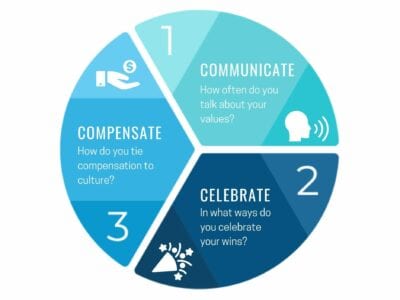
The question of who "owns" a company culture is a tricky one. There are lots of right answers that are wrong, and lots of wrong answers that are right. Let me try to make some sense of all of this for you.


The question of who "owns" a company culture is a tricky one. There are lots of right answers that are wrong, and lots of wrong answers that are right. Let me try to make some sense of all of this for you.

The "Stop Doing List" has been one of the most painful but powerful tools I have had to learn to use over the last 13 years of running a successful small business.

Do you have executives or leaders? Unfortunately, many founders and CEOs make the tragic mistake of assuming achievement is the same as leadership. However, the primary function of an executive team is not achieving today's success but instead securing tomorrow's success.

Day two of your executive offsite is where the rubber meets the road and where discussion transforms into action! You’ll pick up right where you left off in day one, with goals. As the day progresses, you and your team will get increasingly precise until you've boiled those goals down to the specific, actionable tasks that you can assign to your team members.

From day one, this step-by-step agenda will give you and your team an opportunity to reflect on past successes and challenges and cast a vision for the company so powerful and enduring that it will outlast everyone in the room.

After enjoying the organic growth stage in your organization, you will come face to face with the reality that Ownership and Self-Accountability don't just happen at scale (that is, if you haven't already). Structuring an environment for Ownership and Self-Accountability to thrive may sound foreign and complicated. But it's not. Here's how to do it.

Before you can discover how to restore Ownership & Self-Accountability, you must first decide where you will restore it. There are two routes to Ownership & Self-Accountability, but they go in opposite directions. You need to make sure you pick the route that will get you where you want to go, but most of us try the opposite and fail.

What is the one thing you need to create, sustain, or return to the most successful period in your organization's history? Could it really be just one thing? It can, and it is. But it can be tricky, and it alludes even the best leaders.

Most corporate training is terrible, and one simple driver is responsible, but it's probably not what you think. In this article, you'll learn how to address this issue that is crippling your training and build a program with the power to transform your organization for years to come!

The mere mention of the phrase "corporate training" will send the bravest men and women running in the opposite direction. Most training programs are company killers. Yet, the path to building a brilliant organization that can stand the test of time requires that we build the training program that can make that enduring greatness possible. In this series, you'll learn exactly how you can do just that!

If your leaders are constantly hitting home runs, you have a problem. In fact, you have three problems. Fortunately, there is one simple, even informal, strategy you can use to start solving all three of these problems today.

Creating a world-class mentoring and coaching culture is a bit like standing on the beach looking out at the ocean, wondering how to boil it with nothing but the box of matches in your hand, and then a wave splashing up and soaking the matches.
Bummer.
Fortunately, you can start creating a world-class mentoring and coaching culture today.